Pages

Showing posts with label dabai. Show all posts

Tuesday, February 25, 2020

Pasar Borneo @ Seri Kembangan 2020 (1)

Tenom Coffee
Tenom coffee is a popular specialty coffee drink which originated in Tenom, Sabah.  Among the main and largest producer of Tenom coffee are the Yit Foh Tenom Coffee, Tong Fah Coffee Factory and Fatt Choi Tenom Coffee.

Tenom coffee is made from robusta variety. The coffee bean was processed using traditional firewood and drum rotation methods followed for almost 50 years without adding any artificial ingredients or colourings


 Rokok Nipah
The young fronds of nipa palm ( Nypa fruticans ) are made into cigarette wrappers.


  Keropok Dabai


  Kuih Sarang Semut


  Ragi Tuak


Garam Bario

Pasar Borneo @ Seri Kembangan 2020 (2)

Tuhau ( Etligera coccinea )
Tuhau ( in Kadazan ) or upa kecala  ( in Iban ) is one of the most popular traditional food in Sabah and Sarawak.    It is usually eaten as salad, cooked with meat, or made into pickles.  


Pinang ( Areca catecu )
Buah pinang ( betel nut ) is one of the main ingredient in menyirih, a popular custom of S.E.Asia.


Kulat Sisir ( Schizophyllum commune )
Kulat sisir grows abundantly on fallen rubber trees throughout Sarawak.  Rubber was once an important commodity crop, but had declined over the years.  Follow suit is lots of abandoned rubber plantations, and thus lots of kulat sisir.    Kulat sisir is usually cooked with anchovies, chili and coconut milk.


Kulat Pik ( Auricularia auricular-judea )
Kulat pik is found worldwide, thus is known as different name in different culture.   In Sarawak, kulat pik is cooked with chicken.


Sea Bird Nest ( Eucheuma cottonii )
Sea bird nest is a seaweed cultivated off-coast Sabah.  It is consumed fresh as appetizers, made into jelly, or as ingredient in tongsui.
Buah Melinjau ( Gnetum gnenum )
Immature melinjau fruit can be cooked as green.  The seed are powdered, then made into keropok.


Pekasam Ensabi ( Brassica juncea Ensabi )
Ensabi is local variety of mustard green.  The Ensabi leaves is first dehydrated via salt, then fermented in rice water for one week.


Buah Dabai ( Canarium odontophyllum )


Pembangunan Produk Berasaskan Buah Dabai


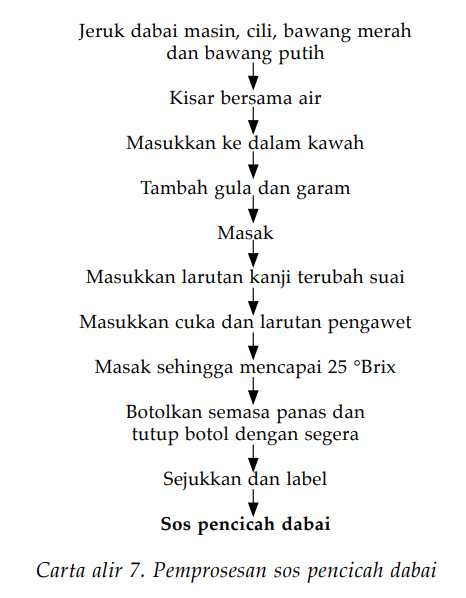
Selain dimakan dalam bentuk buah segar, dabai turut berpotensi untuk dijadikan sebagai ramuan dalam inovasi produk makanan nilai tambah. Antara produk nilai tambah yang berpotensi untuk dibangunkan daripada dabai termasuk buah dan  pulpa sejuk beku, minuman buah, mayonis, halwa, keropok, jeruk masin, sos pencicah dan pes perencah.


Buletin Teknologi MARDI, Bil.5(2014): 51 – 61
Pembangunan produk berasaskan buah dabai
Chua Hun Pin dan Nicholas Daniel

Saturday, February 13, 2016

Stir-Fry Preserved Dabai


This is stirfried preserved dabai ( fruit of Canarium odontophyllum ), a recipe by my makcik from Matu.

Dabai is a very highly perishable fruit.   It is available only end of the year, usually from November to December.  A few weeks later, and it'll disappear from the morning market.  

Many try to preserved it, a lot failed.   Few succeeded.  Among the one who succeeded is my makcik from Matu.   

First, the dabai is soaked in warm saline water till its softened.   Then the flesh and the seed are seperated.  The flesh, is then frozen.

Whenever crave for dabai, just unfreeze the frozen. sauté over some minced garlic or anchovies.   Serve with rice.


Friday, March 8, 2013

Dabai - A Folklore Freeze-Storing Technique


Dabai ( Canarium odontophyllum ) is an exotic fruit indigenous to Sarawak.  It is normally consumed as vegetable, occasionally made into cakes.

Dabai is a seasonal fruit, available at the same time as the durians.     It is pre-soaked in warm water to softened it before consuming with some soy sauce and sugar.  It’s a bit creamy, some describe it as similar to avocados.  An acquired taste, I may put it, not everyone would enjoy it.   Yet, it is still a well received fruit-vegetable among Sarawakians.

However, dabai is a highly perishable produce.  It cannot be stored for long after harvest.  Once soaked, it must be consumed immediately.   So, it is very hard to acquire during off-seasons.


One day, in Miri’s Aunt Hong new house, I learned that there is a folklore technique to store the dabai fruits.   The fruits are kept in the freezer, without being pre-washed.  When required, wash and put the dabai in room temperature to defrost.  Once its defrosted, just add in soy sauce and sugar to marinate.  Soaking in warm water not required, as the freezing will damage the plant cell membranes, resulting of the dabai fruits to softened. 

Apparently, the freezing burst the plant cells as moisture will slightly expand when reaches temperature of approximately 4°C.   When water almost reaches the freezing point, it expand by approximately 9%.  Damages on cell wall means softening of tissue.      

However, the freezing method requires more proper study.


Friday, November 13, 2009

Dabai

Dabai, Canarium odontophyllum, is a member of family Burseraceae is a seasonal fruit found in Sarawak markets, especially toward the end of the year. The outer skin is dark purplish, with yellowish mesocarp. It has hard triangular big seed with edible cotyledon. Dabai also know as 橄榄 ( ca' na , literally olive) among the Chinese community, due to its similarity in shape of olive fruits.

The fruit is pre-soaked for 5 - 10 minutes in warm water prior to consumption. It’s soft, creamy with slight eccentric taste of its own. Locals often have it slightly marinated with sugar and soy sauce. Alternatively, some prefer to sun-cook it. Sun-cook is an interesting process . . . . The dabai fruits are first mixed with soy sauce and sugar, then it’s left under hot sun until the flesh turn soft.

It is interesting to know that the de-skinned dabai flesh is made into dabai cake ! It tastes just as eccentric as the fresh fruit.

The cotyledon too is edible. But getting to it through its hard seed is not an easy task at all. One must use a huge chopping knife, or a nut cracker to get to it.