Pages

Showing posts with label experimental cooking. Show all posts

Tuesday, May 22, 2012

Pineapple Curry - Experimental Cooking


First, saute some garlic together with few chili peppers.  Then, add in some sliced lean pork/chicken breast.  Stirfry for a while till the meat is half-cooked. 
Then, add in pineapple, stirfry a bit.  Add in 1 glass of water. 
Add in curry powder and salt.
Simmer the whole thing for a while.

Serve hot with rice.

Wednesday, July 27, 2011

清炒田七菜 Stir-fried Madeira vine - Experimental Cooking


田七菜 is Anredera cordifolia commonly known as Madeira vine, originated from South America. 

It is known as 落葵薯 in Taiwan and China.
In Malaysia, it grows vigorously in Cameron Highlands as a greens   But soon it gets wild and becomes a noxious weed.  For the sake of marketing this wildly grown liana, the local farmers named it 田七菜,  as its aerial tubers are similar to Panax notoginseng's, the real 田七, an invaluable herb. 

The tubers and leaves are edible.


I just simply stir-fry it with a bit of garlic ( garlic is an utmost important  ingredient in Chinsese style-stir-fry dishes ) and sliced chicken breast.  It is slimy and smooth in taste.


Friday, July 22, 2011

炒木瓜 Stir-fried Papaya - Experimental Cooking


It had been quite a long time since I last experimenting with papaya in kitchen. 

This time, I stir-fried it !  Sound scary ?

Lets get started !.... first I saute some anchovies.  Then put in the sliced papaya.  Just make sure the papaya is not too  ripe and soft.  Pour in a bit water and simmer for a while.  Just add salt to taste.

Thursday, July 21, 2011

南瓜糖水 Pumpkin Tongsui - Experimental Cooking


Ingredients :

1. Pumpkin, skinned, in chunk, 1kg
2. 2 liter water
3. 100g  pearl tsagu
4. sugar, 4 table spoon


First, cook the pumpkin in the water till they are cooked and softened.  Add in the sugar.
Meanwhile, in another smaller pot, boil the pearl sagu till they turned translucent. ( see smaller picture )

Puree the cooked pumpkin with a food processor. 
Add in the pearl sagu.  Stir to mix well.

Serve hot.


cooked pearl sagu are translucent

Wednesday, July 20, 2011

Meranti Soup - Experimental Cooking

Sayur meranti is said to be Solanum americanum.  Others claim it to be S. nigrum  
The Malay name ‘meranti’ is more popularly tagged as a timber tree of Shorea genus.

I asked my Indonesian workers how to cook this leafy plant.  They replied me unanimously : ”masak lemak“, which means ’cook with coconut milk‘.  
OMG ! Is it the only way to cook it?  Is it the only way they cook everything ?

Nevertheless, I decided NOT to listen to them. 


Meranti is a small shrub with small white flowers.  The stem are more tender near to the shoots.  Older stems are harder.  So I take only the shoots and leaves, and discard most of the stems.   

First I saute some garlic, then add in some sliced chicken breast.  Stir for a while.
Add in water.   Add in all the meranti leaves and some rice wine.  Bring to boil.
Add a bit salt to taste.

The taste is in-no-way I can describe.  Its not at all similar to any other greens.  Eccentric taste !

Although meranti are reported to be poisonous, they are eaten as greens in many part of the world.   The green fruits contain high levels of solanine and solamargine, hyoscine, hyoscyamine, and many other toxic glycoalkaloids.  So, eat at your own risk !     

Friday, June 3, 2011

Petai Belalang Sambal Belacan - Experimental Cooking


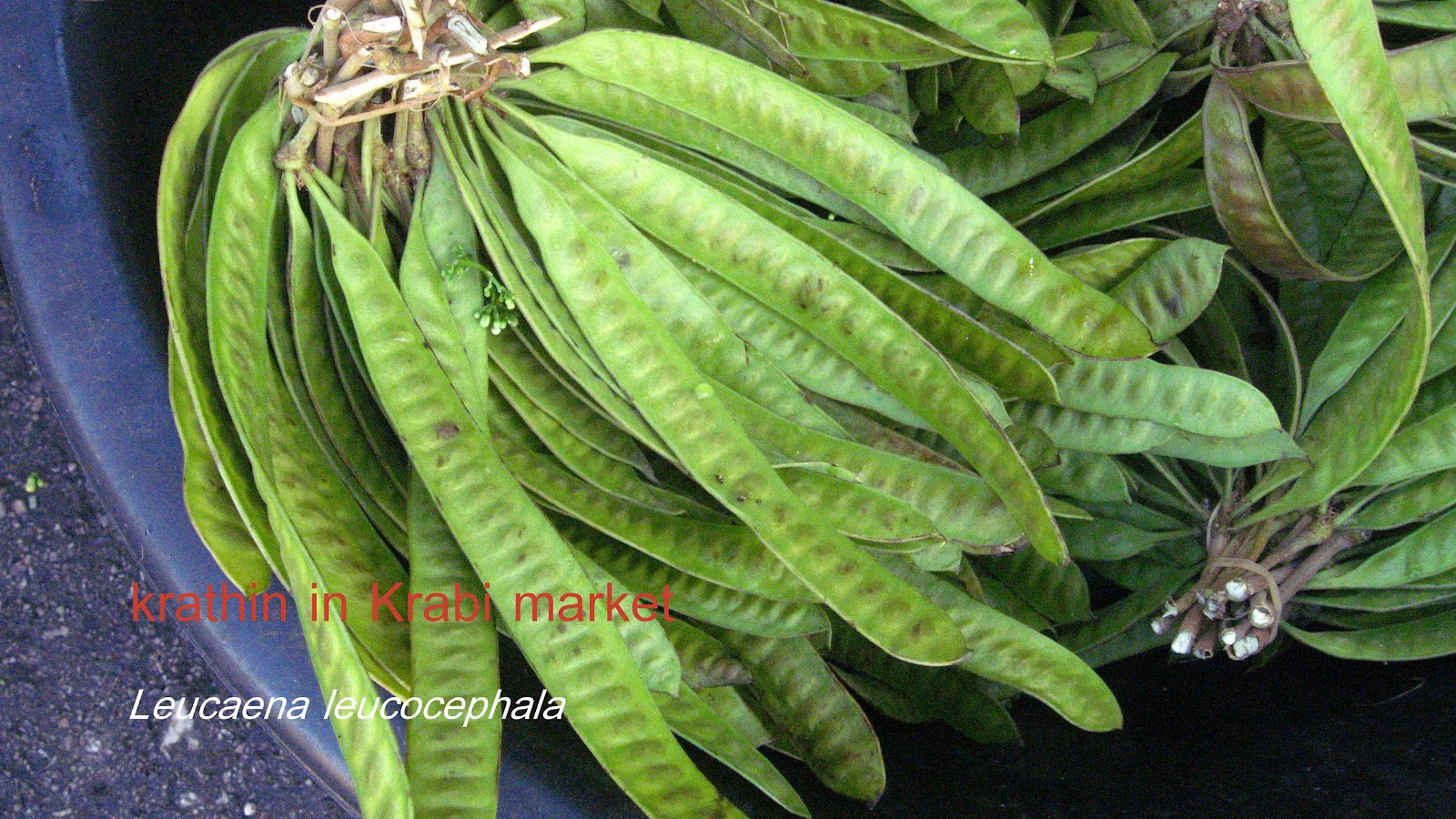
Petai belalang is  the name the local Malays call Leucaena leucocephala.  Wikipedia says that the Indonesians call it petai cina or lamtoro, while the Thais call it krathin

Petai belalang is definitely edible.  The taste is almost similar to petai ( Parkia speciosa ), only smaller in size. 

However, petai belalang is said to contained mimosine, a toxic non-protein acid amino.  Mimosine is reported to halt diving cell in the late G1 phase by inhibiting DNA replication. ( meaning what ? )  Mimosine is also said to caused lathyrism and depilation in some livestock.  However, fortunately for ruminants, mimosine is degraged to 3,4-DHP and 2,3-DHP, then further digested to non-toxic compound.

So,  it is not advisable to consume a large quantity of petai belalang.   Yet, if someone is lost in a tropical jungle or some inhabited island, I guess there are not much choice after all.   Unless there are a lot of mangoes and coconuts available.   Btw, I remember seeing Jack ( the main character in LOST, an American serial drama tv series on ABC ), in one of the final episode of Season 6,  standing by a thicket of petai belalang … do they ever know that its edible ?  


Some 10 immature pods of petai belalang only yield to a few spoonful of edible seeds.  The pods are dehiscent, meaning they will crack-opened when dried.  Immature pods are harder to open, but I soon discovered an easy way to extract the seeds : peel open from the rear end of the pod.  Easy eh ?!

I stir fried them with belacan and pounded Sarawak smoked prawns, just as a petai belacan dish would be.  The taste is less pungent than petai, more tender, less mouthful, yet still have some bitter aftertaste.

Thursday, November 25, 2010

Umbut Sawit - Experimental Cooking

Palm heart, also called palmito, burglar’s thigh, palm cabbage, swamp cabbage, or umbut ( Malay ), is a vegetable harvested from the inner core and growing bud of certain palm trees ( notably the coconut ( Cocos nucifera ), oil palm ( Elaeis guineensis ),  Eutere edlis , Euterpe oleracea , Sabal spp ,  Bactris gasipaes , Deckenia nobilis ).  It is costly because harvesting kills the tree.  Heart of palm often eaten cooked, or fresh as salad.  It is sometimes called the ‘millionaire’s salad’.

There are domesticated palm species which are self-suckering and produce multiple stems.  The main domesticated species is Bactris gasipaes, known as the ‘peach palm’.


In Malaysia, I encountered 2 type of palms harvested for its umbut : coconut and oil palm.   Coconut has been the traditional choice.  However, oil palm is becoming a popular alternative since it was planted abundantly in plantations.  It grows easily in almost any soil conditions, making it a noxious weed at times.   Thus removing a weed oil palm, at the same time harvesting its umbut, is killing 2 birds with 1 stone, an exhausted yet fruitful task.


The simplest way to cook an oil palm heart is clear soup with dried anchovies and chilies, a straightforward way to enjoy its natural taste and texture.
On the other hand, Malaysia has some 3.38 millioin hectare of various stages of oil palm planted in 2000.  Their hearts can be harvested for comsumption, when these oil palm grow old and need to be replanted, instead of just destroy them.  So, we will have all-we-can-eat supply of oil palm heart !

Monday, November 1, 2010

Papaya Soup - Experimental Cooking

I bought 2 unripe papayas last week, hoping they would ripen in a few days.  But they started to develop lesions before managed to ripe.   ( … better not buy unripe papaya anymore )

I had no choice but to cut it premature.  The semi-ripe papayas are somehow too bland for any tongue.

So… instead of torturing myself with tasteless papayas, I throw in into a pot with some minced chicken and some 2liters of H2O.  After simmer for a while, and a pinch of salt and MSG,  voilà !  Papaya soup for dinner !

Thursday, June 3, 2010

Umbuk Pisang masak Sardin - Experimental Cooking


Liza says umbuk masak kari is the best. Hong says she cooked with sardine. I’d tried the simplest umbuk masak sup, so this time I might want to try something different, but not as complicated.
.

This time, after slicing the umbut, I manually remove all the latex… quite a tedious task it is, but worth the effort.
.

As usual, sauté some garlic, then add in 1 can of sardine, 3 cut tomatoes, 3 sliced onions, 1 chopped carrot, and the umbut. Bring everything to boil. Add in some chili for extra ‘kick’…. And it’s done !

Wednesday, May 26, 2010

Umbuk Pisang Masak Sup - Experimental Cooking


I remember eating the pith ( umbut in Malay language ) of banana trunk. Yet, I dun remember when. I remembered people talking about dishes of umbut pisang. Or it is I remembered wrongly. Mind does play tricks, you know..


.

There are several plants of which their piths and young shoots are edible. Among them are bamboo, and coconut, oil palm, banana…..

Enough of talking. It’s time to make things happen.
.

The banana tree ( technically it’s not a tree, it’s a giant herbaceous plant ) is peeled tilk the core, the pith, that is. The banana tree must never bore fruit. As once banana fruits, it's pith will be hardier. Lagipun, banana won't fruit twice ( Ta’kan pisang berbuah dua kali, the Malay says ), after fruiting, the tree will be chopped down. It’s not productive anymore, put to death lah.


Make sure peel till the 2nd layer, where the pith is tender, easily snapped. The innermost layer is the best part ! Slice the pith evenly, about 0.5cm thick. There is some sort-of-latex forming once the pith is cut. Never mind that. Won’t die eat that.


Sauté some garlic, anchovies, chilies. Then pour in a bowl of water, bring to boil. Add in the pith slices. Lastly, little salt to taste.


It’s done ! It tastes good. I’m not dead yet, that’s for sure.


The local Malays cooked it with curry or asam. They say that the latex substance will dilute in acidic media. Well, try it out la !